
Introduction
Master Everyday English Expressions with hilarious awkward moments, meanings, examples, and real-life usage for fluent daily conversations.
Have you ever tried to compliment someone sincerely, only to watch them stare at you as if you had just insulted their entire family tree?
Or maybe you laughed nervously after saying something embarrassing, hoping everyone would magically forget it happened.
Awkward moments are universal. They happen in classrooms, offices, family gatherings, video calls, weddings, and even while ordering tea from the same shopkeeper you have known for years. What makes these moments unforgettable is not just the embarrassment, but the language that surrounds them.
That is exactly why learning Everyday English Expressions is so important.
Most English learners study grammar for years but still struggle when real conversations become emotionally uncomfortable, socially confusing, or unintentionally funny.
Native speakers rely heavily on expressions and idioms during these moments. If you understand them, your English suddenly feels more natural, confident, and human.
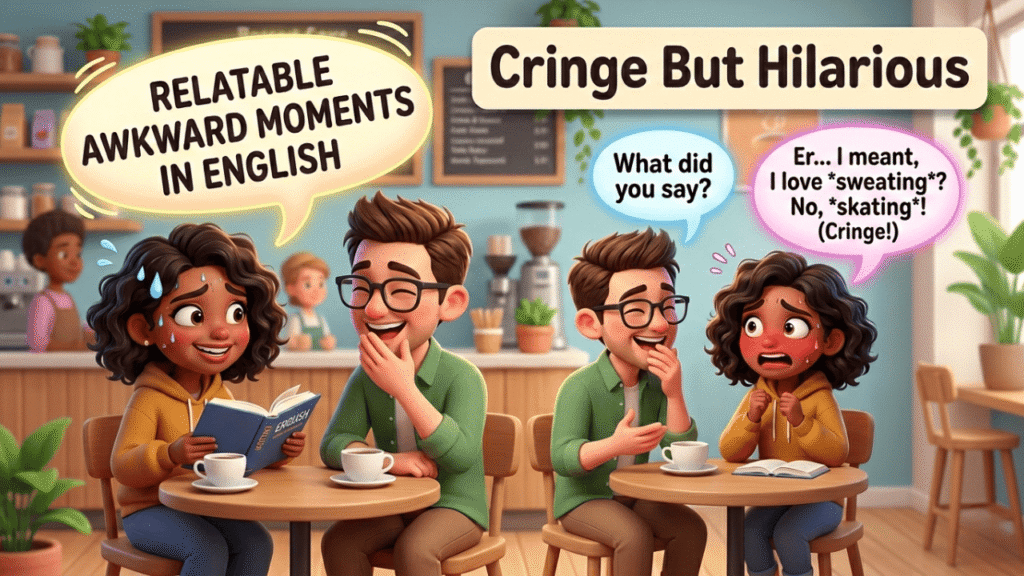
This article explores some wonderfully awkward yet useful expressions featured in the latest Flair For Words video, a sitcom-like learning experience built around relatable social disasters that somehow become funny later.
If you are searching for:
English words with meaning
Daily use of English words with meaning
Basic English words with meaning
vocabulary words with meaning
Then this guide will help you understand how these expressions truly work in everyday communication.
Unlike robotic textbook explanations, here you will learn vocabulary through emotions, misunderstandings, social mistakes, and painfully relatable situations.
Because honestly, language sticks better when it makes you laugh a little.
Table of Contents
About Flair for Words
Flair for Words began as a vocabulary-focused YouTube channel explaining one useful word each day through short and engaging videos. Over time, the channel expanded into IELTS speaking topics and practical communication lessons.
Now, the content has evolved into something even more relatable.
The latest videos combine Everyday English Expressions with sitcom-style storytelling. They revolve around cringe-worthy but hilarious situations that happen in ordinary life.
Moments where someone says the wrong thing, misunderstands a compliment, accidentally embarrasses themselves, or desperately tries to recover from a social disaster.
These videos are educational without feeling heavy. Even viewers who are not intentionally studying English often stay because the scenes feel familiar, funny, and surprisingly comforting.
The goal is simple:
To help learners improve their Daily use of English words with meaning while smiling through the awkwardness of real life.
Why Everyday English Expressions Matter More Than Fancy Vocabulary
Many learners focus only on difficult vocabulary because they believe advanced words automatically make them sound fluent.
That is not entirely true.
Real fluency comes from understanding how people actually speak during normal human situations.
For example:
A native speaker rarely says:
“I made a socially inappropriate verbal mistake.”
They simply say:
“I really put my foot in my mouth.”
That is why learning Everyday English Expressions matters so much.
These expressions help you:
Sound natural
Understand movies and sitcoms
Improve IELTS Speaking fluency
Express emotions clearly
Handle awkward situations better
Communicate confidently in casual conversations
Now, let us dive into the vocabulary from the video.
1. PLAY SOMETHING OFF (Phrasal Verb)
📖 IPA: /pleɪ ˈsʌmθɪŋ ɒf/
🔊 Pronunciation (Hindi – Devanagari): प्ले समथिंग ऑफ
💡 Meaning (Simple): To pretend that something embarrassing or serious is not important.
💡 Meaning (In a sentence): When you play something off, you try to hide embarrassment, awkwardness, or discomfort by acting casual or joking about it.
📝 अर्थ (Hindi): किसी शर्मनाक या असहज स्थिति को सामान्य दिखाने की कोशिश करना
📌 Collocations: play it off casually, play something off with humor, play off embarrassment, play off an awkward moment
⚡ Preposition / Pattern: play something off as something
🎭 Formality: This phrasal verb is common in spoken English, casual conversations, storytelling, and IELTS Speaking answers. Avoid using it in highly formal academic writing.
Examples
He spilt coffee on himself but tried to play it off coolly.
She laughed and played the mistake off as if nothing had happened.
I accidentally called my teacher “Mom” and tried to play it off.
He played off the awkward silence with a joke.
Sometimes confidence is just pretending long enough to play something off.
This is one of those Everyday English Expressions that instantly makes your English sound more conversational.
2. PUT YOUR FOOT IN YOUR MOUTH (Idiom)
📖 IPA: /pʊt jɔːr fʊt ɪn jɔːr maʊθ/
🔊 Pronunciation (Hindi – Devanagari): पुट योर फुट इन योर माउथ
💡 Meaning (Simple): To say something embarrassing or inappropriate accidentally.
💡 Meaning (In a sentence): When you put your foot in your mouth, you unintentionally say something that makes a situation awkward or hurts someone’s feelings.
📝 अर्थ (Hindi): गलती से ऐसी बात कह देना जिससे शर्मिंदगी या असहज स्थिति पैदा हो जाए
📌 Collocations: completely put your foot in your mouth, accidentally put your foot in your mouth, put your foot in your mouth during conversation, put your foot in your mouth again
⚡ Preposition / Pattern: put your foot in your mouth about something
🎭 Formality: This idiom is extremely common in spoken English and storytelling. It works very well in informal conversations and IELTS Speaking responses. Avoid using it in formal reports or academic essays.
Examples
I really put my foot in my mouth at dinner yesterday.
She asked when his wife was due, but he was not married.
He put his foot in his mouth by mentioning salary at the interview.
I tried to compliment her haircut and somehow offended her instead.
Some people are not rude; they just constantly put their foot in their mouth.
Honestly, almost everyone has experienced this kind of awkwardness. That is why this expression appears frequently in sitcoms and daily conversations.
3. BLUNDER (Noun / Verb)
📖 IPA: /ˈblʌndər/
🔊 Pronunciation (Hindi – Devanagari): ब्लंडर
💡 Meaning (Simple): A careless or embarrassing mistake.
💡 Meaning (In a sentence): A blunder is a noticeable mistake caused by confusion, carelessness, or poor judgment, often creating embarrassment.
📝 अर्थ (Hindi): बड़ी या शर्मनाक गलती
📌 Collocations: make a blunder, embarrassing blunder, social blunder, avoid a blunder
⚡ Preposition / Pattern: blunder into something
🎭 Formality: This word works in both spoken and written English. It can be used casually or semi-formally, especially while discussing mistakes or awkward situations.
Examples
Forgetting her name was a terrible blunder.
He made a social blunder during the meeting.
I accidentally waved back at someone who was not waving at me. Classic blunder.
Even confident people make blunders sometimes.
The funny thing about a blunder is that it feels huge only at the moment.
Learning words like this improves your understanding of the daily use of English words with meaning because these situations happen constantly in real life.
4. CRINGE-WORTHY (Adjective)
📖 IPA: /krɪndʒ ˈwɜːrði/
🔊 Pronunciation (Hindi – Devanagari): क्रिंज वर्दी
💡 Meaning (Simple): So awkward or embarrassing that it makes people uncomfortable.
💡 Meaning (In a sentence): Something cringe-worthy causes second-hand embarrassment because it feels painfully awkward or socially uncomfortable.
📝 अर्थ (Hindi): इतना शर्मनाक या अटपटा कि देखकर असहज महसूस हो
📌 Collocations: cringe-worthy moment, cringe-worthy joke, cringe-worthy conversation, painfully cringe-worthy
⚡ Preposition / Pattern: something is cringe-worthy
🎭 Formality: This expression is highly common in modern spoken English, social media, and casual conversations. It is informal and should not be used in highly academic writing.
Examples
His attempt at flirting was unbelievably cringe-worthy.
Watching old school videos can feel cringe-worthy.
The silence after the joke was painfully cringe-worthy.
Some awkward moments become funny years later.
We all have at least one cringe-worthy memory that wakes us up at 2 a.m.
Among modern Everyday English Expressions, this one has become extremely popular online.
5. LAUGH SOMETHING OFF (Phrasal Verb)
📖 IPA: /læf ˈsʌmθɪŋ ɒf/
🔊 Pronunciation (Hindi – Devanagari): लाफ समथिंग ऑफ
💡 Meaning (Simple): To treat something embarrassing or unpleasant as funny instead of serious.
💡 Meaning (In a sentence): When you laugh something off, you respond to embarrassment or criticism with humor so the situation feels lighter.
📝 अर्थ (Hindi): किसी शर्मनाक या कठिन स्थिति को हँसकर टाल देना
📌 Collocations: laugh it off, laugh off embarrassment, laugh something off casually, laugh off criticism
⚡ Preposition / Pattern: laugh something off
🎭 Formality: This phrasal verb is widely used in spoken English and informal communication. It works especially well in storytelling and personal experiences.
Examples
She laughed off the awkward misunderstanding.
He spilt water during the presentation but laughed it off.
Sometimes the best survival skill is learning to laugh things off.
I tried to laugh off my mistake, but inside I was dying.
Confident people are not perfect; they just laugh things off better.
This phrase is essential if you want your Everyday English Expressions to sound emotionally natural.
6. SLIP-UP (Noun)
📖 IPA: /ˈslɪp ʌp/
🔊 Pronunciation (Hindi – Devanagari): स्लिप अप
💡 Meaning (Simple): A small mistake made accidentally.
💡 Meaning (In a sentence): A slip-up is a minor error, often caused by nervousness, distraction, or forgetfulness.
📝 अर्थ (Hindi): छोटी लेकिन अनजाने में हुई गलती
📌 Collocations: minor slip-up, embarrassing slip-up, verbal slip-up, harmless slip-up
⚡ Preposition / Pattern: make a slip-up
🎭 Formality: This word is commonly used in spoken English and informal writing. It is suitable for conversations, interviews, and IELTS speaking contexts.
Examples
Everyone makes slip-ups occasionally.
Calling your teacher by the wrong name is a classic slip-up.
It was just a harmless slip-up.
Nervousness often leads to verbal slip-ups.
One small slip-up should not define your confidence.
Words like this strengthen your knowledge of Basic English words with meaning because they appear naturally in everyday interactions.
Why Sitcom-Style Learning Works So Well
Traditional vocabulary learning often fails because it removes emotion from language.
But when you connect words to embarrassment, humor, confusion, or awkwardness, the brain remembers them more easily.
That is why sitcom-style English lessons work beautifully.
You do not just learn definitions. You remember:
The awkward pause
The misunderstanding
The accidental insult
The desperate recovery attempt
This emotional connection makes Everyday English Expressions far easier to remember.
How These Expressions Improve IELTS Speaking
Many IELTS learners sound overly formal because they memorise textbook English.
Real fluency comes from sounding human.
Using expressions like:
laugh it off
put your foot in your mouth
play something off
can make your speaking feel more natural and conversational.
Examiners often notice when a learner uses idiomatic language comfortably.
That does not mean overusing idioms. It means using them naturally in the right context.
How to Practice These Expressions Daily
If you truly want to improve your Daily use of English words with meaning, try this simple method:
- Watch relatable content
- Sitcoms, interviews, and conversational YouTube videos help enormously.
- Speak aloud
- Use these expressions while narrating your day.
- Create imaginary awkward scenarios
- This sounds silly, but it works brilliantly.
- Write mini-dialogues
- Short conversations improve retention.
- Laugh at your mistakes
Seriously, this might be the most important step.
Language learning becomes easier when embarrassment stops feeling dangerous.
Conclusion
Awkward moments are part of being human.
Sometimes you say the wrong thing. Sometimes people misunderstand you. Sometimes you try to recover gracefully and somehow make everything worse.
But strangely, these moments are also where language becomes most alive.
Learning Everyday English Expressions through relatable situations helps you sound more fluent, more expressive, and more emotionally natural in conversations.
The expressions covered today, play something off, put your foot in your mouth, blunder, cringe-worthy, laugh something off, and slip-up, are not just vocabulary items. They are pieces of real communication.
And perhaps that is the beauty of learning English through awkward moments.
You stop trying to sound perfect.
You start sounding real.
Other topics you may like: 6 Surprisingly Powerful Everyday English Phrases and Words That Can Make or Break Your Conversations.
FAQs
1. What are the best Everyday English Expressions for awkward situations?
Expressions like “put your foot in your mouth,” “laugh it off,” and “play something off” are extremely useful during embarrassing or socially awkward moments.
2. How can I improve my Daily use of English words with meaning?
Practice vocabulary through real-life situations, storytelling, sitcoms, and speaking exercises instead of memorising isolated definitions.
3. Why are idioms important in spoken English?
Idioms help conversations sound more natural, emotionally expressive, and fluent. Native speakers use them frequently in casual communication.
Pingback: 6 Unforgettable Everyday English Conversations