
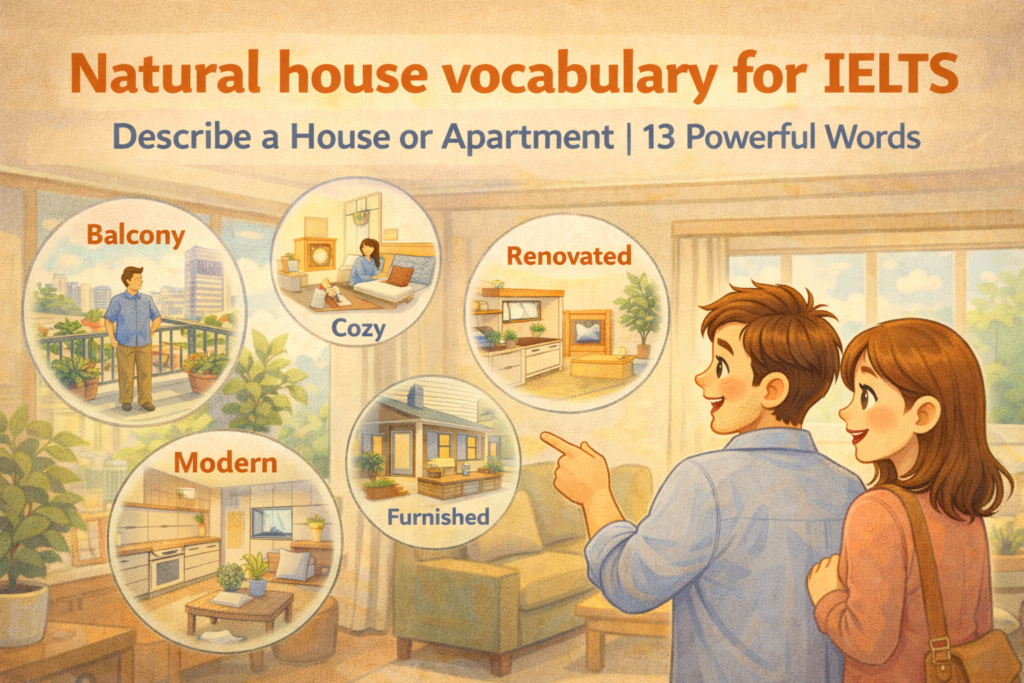
When talking about houses or apartments in English, many learners rely on basic words like big, small, or nice. However, if you want to sound fluent and confident in the IELTS Speaking test, you need natural housing vocabulary to describe living spaces more precisely.
Using natural house vocabulary for IELTS helps you explain comfort, design, space, and atmosphere clearly. Instead of saying a house is “nice,” you might describe it as spacious, well-lit, or tastefully decorated. This natural vocabulary for IELTS makes your answers richer and more natural.
In IELTS Speaking Part 2, topics about homes and living spaces appear frequently. By learning natural house vocabulary for IELTS, you can describe apartments, houses, neighbourhoods, and living conditions more effectively.
The expressions in this lesson will help you strengthen your natural house vocabulary for IELTS and speak more confidently about housing topics.
Table of Contents
Now let’s explore this natural house vocabulary for IELTS in detail.
1. SPACIOUS (Adjective)
📖 IPA: /ˈspeɪʃəs/
🔊 Pronunciation (Hindi – Devanagari): स्पेशस
💡 Meaning: Having plenty of space; not crowded.
📝 अर्थ: खुला और बड़ा
📌 Collocations: spacious living room, spacious apartment, spacious kitchen, spacious layout
⚡ Pattern: be spacious
🎭 Formality: Neutral. This word is common in everyday conversation and IELTS Speaking answers when describing homes. It is also acceptable in formal descriptions.
Example 1: The apartment is surprisingly spacious for a city flat.
Example 2: They bought a spacious house with a large garden.
2. COZY (Adjective)
📖 IPA: /ˈkoʊzi/
🔊 Pronunciation: कोज़ी
💡 Meaning: Warm, comfortable, and inviting.
📝 अर्थ: आरामदायक और सुकूनभरा
📌 Collocations: cozy bedroom, cozy living space, cozy atmosphere, cozy corner
⚡ Pattern: feel cozy
🎭 Formality: Neutral–Informal. Common in spoken English and IELTS Speaking answers describing homes. Avoid in very formal architectural writing.
Example 1: The small apartment felt cozy and comfortable.
Example 2: She created a cozy reading corner near the window.
3. CRAMPED (Adjective)
📖 IPA: /kræmpt/
🔊 Pronunciation: क्रैम्प्ट
💡 Meaning: Too small or crowded to be comfortable.
📝 अर्थ: तंग
📌 Collocations: cramped apartment, cramped living conditions, cramped space, cramped kitchen
⚡ Pattern: feel cramped
🎭 Formality: Neutral. Suitable for IELTS Speaking when comparing housing conditions.
Example 1: The room felt cramped with too much furniture.
Example 2: Living in a cramped apartment can be stressful.
4. COMPACT (Adjective)
📖 IPA: /ˈkɒmpækt/
🔊 Pronunciation: कॉम्पैक्ट
💡 Meaning: Small but efficiently arranged.
📝 अर्थ: छोटा लेकिन सुव्यवस्थित
📌 Collocations: compact apartment, compact layout, compact design, compact living space
⚡ Pattern: be compact
🎭 Formality: Neutral–Formal. Often used in real estate descriptions.
Example 1: The apartment is compact but functional.
Example 2: A compact design makes the space efficient.
5. WELL-LIT (Adjective)
📖 IPA: /wel lɪt/
🔊 Pronunciation: वेल-लिट
💡 Meaning: Having enough natural or artificial light.
📝 अर्थ: अच्छी रोशनी वाला
📌 Collocations: well-lit room, well-lit apartment, well-lit corridor, well-lit living space
⚡ Pattern: be well-lit
🎭 Formality: Neutral. Suitable for spoken and written descriptions of homes.
Example 1: The living room is well-lit with large windows.
Example 2: A well-lit house feels more welcoming.
6. WELL-MAINTAINED (Adjective)
📖 IPA: /wel meɪnˈteɪnd/
🔊 Pronunciation: वेल मेंटेंड
💡 Meaning: Kept in good condition through regular care.
📝 अर्थ: अच्छी तरह संभाला हुआ
📌 Collocations: well-maintained building, well-maintained property, well-maintained apartment, well-maintained garden
⚡ Pattern: be well-maintained
🎭 Formality: Neutral–Formal. Common in property descriptions and IELTS Speaking.
Example 1: The building is well-maintained by the residents.
Example 2: They live in a well-maintained apartment complex.
7. LIVABLE (Adjective)
📖 IPA: /ˈlɪvəbəl/
🔊 Pronunciation: लिवेबल
💡 Meaning: Comfortable and suitable for living.
📝 अर्थ: रहने योग्य
📌 Collocations: livable space, livable environment, livable apartment, livable conditions
⚡ Pattern: be livable
🎭 Formality: Neutral. Used in both conversation and descriptive writing.
Example 1: The house is small but perfectly livable.
Example 2: Good ventilation makes the apartment livable.
8. LOW-MAINTENANCE (Adjective)
📖 IPA: /loʊ ˈmeɪntənəns/
🔊 Pronunciation: लो मेंटेनेंस
💡 Meaning: Requiring little effort to maintain.
📝 अर्थ: कम देखभाल की ज़रूरत वाला
📌 Collocations: low-maintenance apartment, low-maintenance garden, low-maintenance lifestyle, low-maintenance design
⚡ Pattern: be low-maintenance
🎭 Formality: Neutral. Frequently used in property descriptions and everyday conversation.
Example 1: The apartment is low-maintenance and easy to manage.
Example 2: Many people prefer low-maintenance homes.
9. SECURE (Adjective)
📖 IPA: /sɪˈkjʊr/
🔊 Pronunciation: सिक्योर
💡 Meaning: Safe and protected from danger.
📝 अर्थ: सुरक्षित
📌 Collocations: secure building, secure neighbourhood, secure apartment complex, secure environment
⚡ Pattern: feel secure
🎭 Formality: Neutral–Formal. Common in real estate and daily conversation.
Example 1: The building is secure with CCTV cameras.
Example 2: Families prefer living in a secure neighbourhood.
10. INVITING (Adjective)
📖 IPA: /ɪnˈvaɪtɪŋ/
🔊 Pronunciation: इनवाइटिंग
💡 Meaning: Making you feel welcome and comfortable.
📝 अर्थ: आकर्षक
📌 Collocations: inviting atmosphere, inviting living room, inviting entrance, inviting interior
⚡ Pattern: look inviting
🎭 Formality: Neutral. Often used in home descriptions and IELTS Speaking.
Example 1: The living room looks warm and inviting.
Example 2: Soft lighting creates an inviting atmosphere.
11. THOUGHTFULLY-DESIGNED (Adjective)
📖 IPA: /ˈθɔːtfəli dɪˈzaɪnd/
🔊 Pronunciation (Hindi – Devanagari): थॉटफुली डिज़ाइन्ड
💡 Meaning (English): Planned carefully with attention to comfort, function, and usefulness.
📝 अर्थ (Hindi): सोच-समझकर बनाया गया
📌 Collocations: thoughtfully-designed layout, thoughtfully-designed apartment, thoughtfully-designed interior, thoughtfully-designed living space
⚡ Pattern: be thoughtfully-designed
🎭 Formality: Neutral–Formal. This expression is commonly used in architecture and interior design discussions, and IELTS Speaking answers describing houses or apartments. Avoid overusing it in very casual conversation.
Example 1: The apartment is thoughtfully designed with plenty of storage space.
Example 2: The house has a thoughtfully designed layout that makes it very comfortable to live in.
12. TASTEFULLY DECORATED (Adjective phrase)
📖 IPA: /ˈteɪstfəli ˈdekəreɪtɪd/
🔊 Pronunciation (Hindi – Devanagari): टेस्टफुली डेकोरेटेड
💡 Meaning (English): Decorated in a simple, elegant, and attractive way without being excessive.
📝 अर्थ (Hindi): सलीके से सजाया हुआ
📌 Collocations: tastefully decorated apartment, tastefully decorated living room, tastefully decorated interior, tastefully decorated house
⚡ Pattern: be tastefully decorated
🎭 Formality: Neutral–Formal. Common in home descriptions, real estate listings, and IELTS Speaking answers describing interior design. It sounds natural but should not be overused in very formal academic writing.
Example 1: The living room is tastefully decorated with soft colours and elegant furniture.
Example 2: Her apartment is small but beautifully and tastefully decorated.
13. AIRY (Adjective)
📖 IPA: /ˈeəri/
🔊 Pronunciation (Hindi – Devanagari): एरी
💡 Meaning (English): Light, fresh, and open with good air circulation.
📝 अर्थ (Hindi): हवादार
📌 Collocations: airy apartment, airy living room, airy interior, airy space
⚡ Pattern: feel airy, be airy
🎭 Formality: Neutral. This adjective is commonly used in everyday conversation, home descriptions, and IELTS Speaking answers when talking about ventilation and space. Avoid it in highly technical architectural writing.
Example 1: The apartment feels airy because of its large windows.
Example 2: An airy living room makes the house feel more comfortable and refreshing.
🎓 IELTS Band 9 Sample Answer
Cue Card: Describe a person’s house/apartment that you think is very good
You should say:
Where it is
Whose house/apartment it is
What it looks like
And explain why you like it
Sample Answer:
One house that left a strong impression on me belongs to a close friend of mine who lives in Delhi. His apartment is located in a quiet residential neighbourhood that feels very secure and peaceful.
The apartment itself is surprisingly spacious and airy, which is quite rare in a busy city. The living room is well-lit with large windows, and the entire space is tastefully decorated with minimal yet elegant furniture. What I particularly admire is that the apartment is thoughtfully-designed, so every corner of the house feels functional and comfortable.
Even though the apartment is not extremely large, the compact layout makes it very livable. It also has a cozy atmosphere that makes visitors feel relaxed immediately. The building is well-maintained, and the environment is very secure, which makes it ideal for families.
Overall, I really admire this home because it perfectly balances comfort, design, and practicality. Learning natural house vocabulary for IELTS allows you to describe such living spaces clearly and naturally during the speaking test.
Mastering natural house vocabulary for IELTS is an important step toward improving your fluency and confidence in English. When you describe homes, apartments, and living spaces using precise language, your answers become clearer, richer, and more engaging. Instead of relying on simple words like big or nice, using natural house vocabulary for IELTS allows you to explain details such as comfort, design, lighting, and atmosphere.
In the IELTS Speaking test, examiners pay close attention to lexical resources. This means your ability to use varied and appropriate vocabulary. By learning natural house vocabulary for IELTS, you can describe a spacious apartment, a cozy living room, or a well-maintained building with accuracy and confidence.
Another advantage of building a natural house vocabulary for IELTS is that it helps you speak more naturally about everyday topics. Housing is a common theme in IELTS Speaking Part 1 and Part 2, so knowing natural house vocabulary for IELTS will make it easier to answer questions without hesitation.
The best way to remember this vocabulary is to practise using it in real situations. Try describing your own home or a friend’s apartment using this natural house vocabulary for IELTS. Over time, these expressions will become a natural part of your speech.
Consistent practice is the key. The more you expand your natural house vocabulary for IELTS, the more confident and expressive your English will become.
Other topics you may like: 10 Powerful Advanced Vocabulary for IELTS Speaking to Avoid Embarrassing Memory Mistakes
About My YouTube Channel: Flair for Words
Flair for Words is a vocabulary-focused YouTube channel created for English learners who want to sound fluent, confident, and natural. Each short video explains one powerful English word with clear meaning, pronunciation, and real-life usage. The content is especially helpful for learners preparing for IELTS, TOEFL, and everyday spoken English.
If you enjoy learning advanced but spoken-friendly words in a simple, engaging way, this channel is for you. Each day, a word. Each word, a world. Step into the rhythm with @flairforwords.
What vocabulary is useful for describing houses in IELTS?
Useful words include spacious, cozy, well-lit, airy, secure, compact, and well-maintained. These help describe homes more precisely.
Is “cozy” formal?
Cozy is common in everyday conversation and IELTS Speaking answers describing homes. Avoid using it in highly formal academic writing.