
Introduction
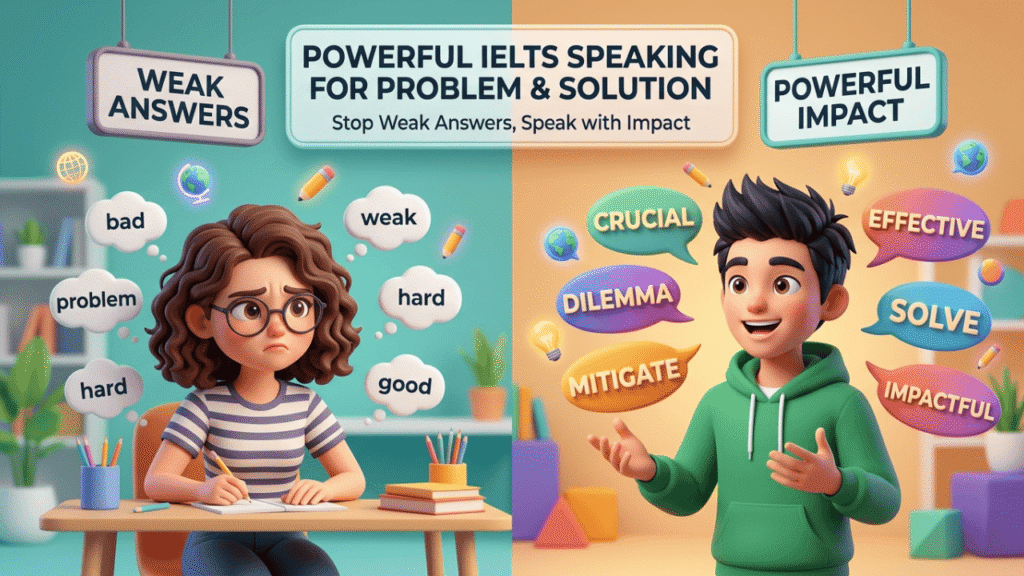
If your IELTS answers feel basic or repetitive, the real issue is not your ideas; it is your vocabulary. To express challenges, solutions, and success clearly, you need strong and precise IELTS Vocabulary for Problem and Solution. Without it, even good ideas sound average.
In this guide, you will learn carefully selected IELTS Vocabulary for Problem and Solution that helps you describe real-life struggles and achievements with confidence. These are not just random lists of English words with meaning; they are practical, high-impact expressions used in real conversations and high-scoring IELTS responses.
Whether you are working on the daily use of English words with meaning or trying to move beyond basic English words with meaning, this lesson will help you upgrade to vocabulary words with meaning that actually work in real speaking situations.
Let us now explore each word in detail and build your IELTS Vocabulary for Problem and Solution step by step.
Table of Contents
Breakthrough (Noun)
📖 IPA: /ˈbreɪkθruː/
🔊 Pronunciation (Hindi – Devanagari): ब्रेकथ्रू
💡 Meaning (English): A sudden and important discovery or success.
📝 अर्थ (Hindi): महत्वपूर्ण सफलता
📌 Collocations: major breakthrough, scientific breakthrough, breakthrough moment, breakthrough discovery
⚡ Usage Pattern: breakthrough in (something)
🎭 Formality: Neutral to formal, commonly used in both professional and IELTS Speaking contexts when describing success. Avoid overusing it in very casual conversation.
Examples:
After months of failure, I finally had a breakthrough in my preparation.
That small idea turned into a major breakthrough in my career.
Come up with something (Phrasal verb)
📖 IPA: /kʌm ʌp wɪð/
🔊 Pronunciation (Hindi – Devanagari): कम अप विद
💡 Meaning (English): To think of or produce an idea or solution.
📝 अर्थ (Hindi): कोई समाधान या विचार निकालना
📌 Collocations: come up with a solution, come up with an idea, come up with a plan, come up with an alternative
⚡ Pattern: come up with (idea or solution)
🎭 Formality: Informal to neutral, very common in spoken English and IELTS Speaking answers. Avoid using it in highly formal academic writing.
Examples:
I had to come up with a quick solution during the exam.
She came up with a brilliant idea to solve the issue.
Work through (Phrasal verb)
📖 IPA: /wɜːrk θruː/
🔊 Pronunciation (Hindi – Devanagari): वर्क थ्रू
💡 Meaning (English): To deal with a problem step by step.
📝 अर्थ (Hindi): धीरे-धीरे हल निकालना
📌 Collocations: work through a problem, work through difficulties, work through challenges, work through emotions
⚡ Pattern: work through (problem or issue)
🎭 Formality: Neutral, widely used in both personal and semi-formal contexts, especially when explaining a process.
Examples:
I worked through the problem slowly until I understood it.
It took time, but I worked through all the challenges.
Resolve (Verb)
📖 IPA: /rɪˈzɒlv/
🔊 Pronunciation (Hindi – Devanagari): रिज़ॉल्व
💡 Meaning (English): To find a solution to a problem.
📝 अर्थ (Hindi): समाधान करना
📌 Collocations: resolve an issue, resolve a conflict, resolve a problem, resolve a dispute
⚡ Pattern: resolve (something)
🎭 Formality: Formal, commonly used in professional, academic, and IELTS contexts.
Examples:
I managed to resolve the issue before the deadline.
The team worked together to resolve the conflict.
Obstacle (Noun)
📖 IPA: /ˈɒbstəkl/
🔊 Pronunciation (Hindi – Devanagari): ऑब्स्टेकल
💡 Meaning (English): Something that blocks progress.
📝 अर्थ (Hindi): बाधा
📌 Collocations: major obstacle, overcome an obstacle, face an obstacle, remove an obstacle
⚡ Pattern: obstacle to (progress or success)
🎭 Formality: Neutral, suitable for both spoken and written English.
Examples:
Lack of time was the biggest obstacle.
I faced several obstacles during my preparation.
Constraint (noun)
📖 IPA: /kənˈstreɪnt/
🔊 Pronunciation (Hindi – Devanagari): कंस्ट्रेंट
💡 Meaning (English): A limitation or restriction.
📝 अर्थ (Hindi): सीमा या प्रतिबंध
📌 Collocations: financial constraint, time constraint, budget constraint, resource constraint
⚡ Pattern: constraint on (something)
🎭 Formality: Formal, often used in academic and professional contexts. Use it carefully in IELTS Speaking for variety.
Examples:
Time constraints made the task difficult.
We had to work under strict budget constraints.
Figure out (phrasal verb)
📖 IPA: /ˈfɪɡər aʊt/
🔊 Pronunciation (Hindi – Devanagari): फिगर आउट
💡 Meaning (English): To understand or find a solution.
📝 अर्थ (Hindi): समझना या हल निकालना
📌 Collocations: figure out a solution, figure out the problem, figure out a way, figure out what to do
⚡ Pattern: figure out (something)
🎭 Formality: Informal to neutral, very common in the daily use of English words with meaning. Avoid using it in formal essays.
Examples:
I finally figured out the answer.
It took me hours to figure out what was wrong.
Overcome (verb)
📖 IPA: /ˌoʊvərˈkʌm/
🔊 Pronunciation (Hindi – Devanagari): ओवरकम
💡 Meaning (English): To successfully deal with a difficulty.
📝 अर्थ (Hindi): पार पाना
📌 Collocations: overcome challenges, overcome fear, overcome difficulties, overcome obstacles
⚡ Pattern: overcome (difficulty or fear)
🎭 Formality: Neutral, very effective in motivational and IELTS contexts.
Examples:
I overcame my fear of speaking English.
She overcame many difficulties to succeed.
Overwhelming (adjective)
📖 IPA: /ˌoʊvərˈwelmɪŋ/
🔊 Pronunciation (Hindi – Devanagari): ओवरवेल्मिंग
💡 Meaning (English): Too much to handle emotionally or mentally.
📝 अर्थ (Hindi): बहुत ज़्यादा या भारी लगने वाला
📌 Collocations: overwhelming pressure, overwhelming feeling, overwhelming situation, overwhelming response
⚡ Pattern: overwhelming (situation or emotion)
🎭 Formality: Neutral, commonly used in spoken English and IELTS answers to express emotions.
Examples:
The pressure was overwhelming at first.
I felt an overwhelming sense of responsibility.
Tackle (verb)
📖 IPA: /ˈtækəl/
🔊 Pronunciation (Hindi – Devanagari): टैकल
💡 Meaning (English): To deal with a problem in a determined way.
📝 अर्थ (Hindi): समस्या से निपटना
📌 Collocations: tackle a problem, tackle an issue, tackle a challenge, tackle a situation
⚡ Pattern: tackle (problem or issue)
🎭 Formality: Neutral, suitable for both spoken and professional contexts.
Examples:
I decided to tackle the problem directly.
The government is trying to tackle the issue.
Band 9 Sample Answer
Cue Card: Describe a difficult thing you did and succeeded in
You should say:
What it was.
Why it was difficult.
What you did.
and explain how you felt about it.
Answer:
One of the most difficult things I did, where I truly applied my IELTS Vocabulary for Problem and Solution, was preparing for a major career transition after leaving my job. It was not just a professional shift, it was an emotional and mental challenge as well.
The biggest obstacle I faced was uncertainty. I had to work through multiple challenges, including time constraints and self-doubt. At times, the situation felt overwhelming, and I honestly did not know how to move forward.
However, instead of giving up, I decided to tackle the situation step by step. I tried to come up with practical solutions and figure out what skills I needed to improve. Slowly, I began to resolve smaller issues, which eventually led to a breakthrough in my confidence.
What made this experience truly transformative was the way I managed to overcome my fears. I realised that every problem has a solution if you are willing to work through it patiently.
In the end, I felt a deep sense of satisfaction. This experience not only improved my confidence but also strengthened my ability to use IELTS Vocabulary for Problem and Solution naturally in real-life situations.
Other topics you may like: Unforgettable Experience Vocabulary for IELTS: Speak Powerful IELTS English Like a Pro.
About My YouTube Channel: Flair for Words
Flair for Words is a vocabulary-focused YouTube channel created for English learners who want to sound fluent, confident, and natural. Each short video explains one powerful English word with clear meaning, pronunciation, and real-life usage. The content is especially helpful for learners preparing for IELTS, TOEFL, and everyday spoken English.
If you enjoy learning advanced but spoken-friendly words in a simple, engaging way, this channel is for you. Each day, a word. Each word, a world. Step into the rhythm with @flairforwords.
Conclusion
Mastering IELTS Vocabulary for Problem and Solution is not about memorising difficult words; it is about using the right words at the right time. When you consistently practise with English words with meaning, and focus on the daily use of English words with meaning, your fluency improves naturally.
If you rely only on basic English words with meaning, your answers will remain limited. But when you actively use vocabulary words with meaning like the ones in this guide, your speaking becomes powerful and precise.
Keep revising this IELTS Vocabulary for Problem and Solution, use it in your daily speaking practice, and you will notice a clear improvement in both confidence and clarity.
FAQs
How can I use problem and solution vocabulary in IELTS Speaking effectively?
Focus on using problem and solution vocabulary naturally within your answers instead of forcing it. Start by describing a challenge, then explain the steps you took to solve it using phrases like “work through,” “tackle,” or “figure out.” This improves both fluency and coherence, which are key scoring criteria.
What are the most common mistakes students make with vocabulary in IELTS Speaking?
Many learners memorise vocabulary words with meaning but fail to use them correctly in sentences. Another common mistake is overusing complex words without understanding their context. It is better to use simple but accurate language than incorrect advanced vocabulary.
How many vocabulary words should I learn daily for IELTS preparation?
Instead of focusing on quantity, aim to learn 5 to 8 high-quality words daily and practise them in speaking. Using daily use of English words with meaning in real sentences is far more effective than memorising long lists of basic English words with meaning.
Pingback: 6 Surprisingly Powerful Everyday English Phrases And Words