
Table of Contents
Why Learning Advanced English Vocabulary Through Comedy Works
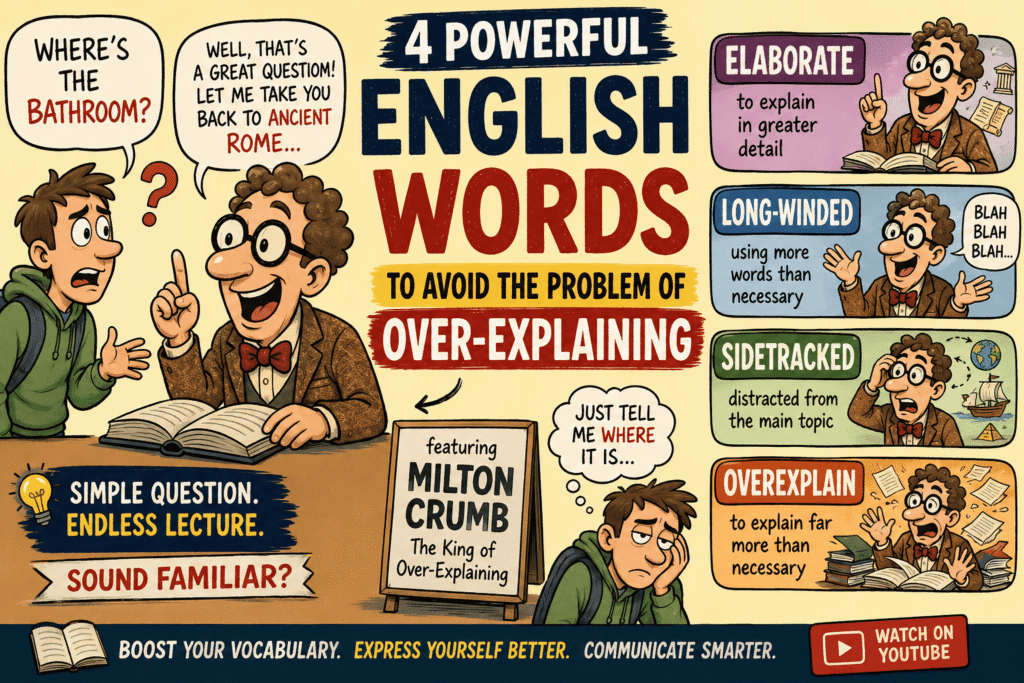
Have you ever asked someone a very simple question, only to receive an answer so long that you forgot what you had asked in the first place?
Imagine asking,
“Where’s the bathroom?”
Instead of pointing in the right direction, the other person begins explaining the history of the building, the architect who designed it, why bathrooms used to be located in different places centuries ago, and how modern plumbing has evolved over time.
By the time they finish, you no longer need the answer. You simply need patience. If that situation sounds familiar, then you’ll probably enjoy meeting Milton Crumb, the unforgettable character from today’s comedy sketch. Milton has one extraordinary talent. He can transform the simplest question into a lengthy lecture filled with unnecessary details. His explanations are informative, but rarely helpful.
This humorous character introduces us to four incredibly useful pieces of advanced English vocabulary that native speakers use to describe communication styles. These words are practical, expressive, and extremely common in conversations, television shows, podcasts, workplaces, and IELTS Speaking tests.
Learning advanced English vocabulary through stories is far more effective than memorizing isolated definitions. Stories help us connect emotions with language, making new words easier to remember and easier to use naturally. In this lesson, you will discover the meanings, pronunciation, Hindi translations, collocations, usage patterns, and examples of four valuable expressions:
• Elaborate
• Long-winded
• Sidetracked
• Overexplain
Whether you want to improve your spoken English, prepare for IELTS, or simply build stronger communication skills, these words deserve a place in your active vocabulary. Throughout this article, you’ll also notice how these expressions fit naturally into everyday conversations. Along the way, you’ll continue expanding your collection of English words with meaning, daily use of English words with meaning, basic English words with meaning, and vocabulary words with meaning that make your English sound more fluent and natural.
So, let’s begin today’s lesson and discover why sometimes the shortest answer is actually the best answer.
Why These Words Matter in Everyday Conversations
Communication is not only about speaking well. It is also about knowing how much to say.
Some people answer questions briefly and clearly.
Others accidentally provide far more information than anyone asked for.
Knowing the right advanced English vocabulary allows you to describe these communication styles accurately.
For example, instead of saying,
“He talks too much.”
You can say,
“He’s a little long-winded.”
Instead of saying,
“She keeps giving unnecessary details.”
You can say,
“She tends to overexplain.”
Learning precise vocabulary makes your English richer, more natural, and much closer to the language used by native speakers.
Now let’s explore each word in detail.
1. ELABORATE (Verb)
📖 IPA: /ɪˈlæbəreɪt/
🔊 Pronunciation (Hindi – Devanagari): इलैबरेट
💡 Meaning (English): To explain something in greater detail or provide additional information to make it clearer.
📝 अर्थ (Hindi): किसी बात को अधिक विस्तार से समझाना या उस पर और जानकारी देना।
📌 Collocations: elaborate on a point, elaborate further, elaborate explanation, elaborate plan, elaborate details
⚡ Preposition / Pattern: elaborate on (something)
🎭 Formality: This verb is common in spoken English, presentations, meetings, academic discussions, workplace communication, and IELTS Speaking answers. It is suitable for both everyday and professional situations.
Examples
- Could you elaborate on your idea?
- The teacher asked the student to elaborate further.
- Milton always elaborates on even the simplest questions.
- She gave an elaborate explanation of the project.
- Please elaborate on how the system works.
2. LONG-WINDED (Adjective)
📖 IPA: /ˌlɒŋ ˈwɪndɪd/
🔊 Pronunciation (Hindi – Devanagari): लॉन्ग विंडिड
💡 Meaning (English): Using more words than necessary, often making an explanation or speech unnecessarily lengthy.
📝 अर्थ (Hindi): ज़रूरत से ज़्यादा लंबा बोलने वाला या बहुत विस्तार से समझाने वाला।
📌 Collocations: long-winded explanation, long-winded speech, long-winded answer, long-winded conversation, long-winded story
⚡ Preposition / Pattern: be long-winded when (speaking), become long-winded about (something)
🎭 Formality: This adjective is common in spoken English, workplace communication, book reviews, presentations, and IELTS Speaking answers. It often carries a mildly negative tone because it suggests that someone talks for too long when a shorter explanation would be better.
Examples
- Milton gave a long-winded explanation about the history of elevators.
- His long-winded speech made everyone lose interest.
- Try not to be long-winded during your presentation.
- The interview became long-winded because every answer included unnecessary details.
- My uncle tells wonderfully funny but extremely long-winded stories.
3. SIDETRACKED (Adjective)
📖 IPA: /ˈsaɪdtrækt/
🔊 Pronunciation (Hindi – Devanagari): साइडट्रैक्ट
💡 Meaning (English): Distracted from the main topic, purpose, or activity because attention has shifted to something less important.
📝 अर्थ (Hindi): मुख्य विषय या उद्देश्य से भटक जाना और किसी दूसरी, कम महत्वपूर्ण बात में उलझ जाना।
📌 Collocations: get sidetracked, become sidetracked, sidetracked by details, sidetracked during a conversation, sidetracked by a question
⚡ Preposition / Pattern: sidetracked by (something)
🎭 Formality: This adjective is common in spoken English, workplace conversations, meetings, presentations, and IELTS Speaking answers. It is especially useful when describing conversations or projects that drift away from the main topic.
Examples
- Milton got sidetracked while explaining where the café was.
- We became sidetracked by an unrelated discussion.
- Don’t get sidetracked by unnecessary details.
- The meeting was sidetracked by questions about last year’s project.
- She often gets sidetracked whenever someone interrupts her.
4. OVEREXPLAIN (Verb)
📖 IPA: /ˌəʊvərɪkˈspleɪn/
🔊 Pronunciation (Hindi – Devanagari): ओवरएक्सप्लेन
💡 Meaning (English): To explain something in far more detail than necessary, often making the explanation longer than the listener needs or wants.
📝 अर्थ (Hindi): किसी बात को आवश्यकता से अधिक विस्तार से समझाना।
📌 Collocations: overexplain everything, overexplain a situation, overexplain yourself, tend to overexplain, overexplain simple questions
⚡ Preposition / Pattern: overexplain (something), overexplain yourself
🎭 Formality: This verb is common in spoken English, social media, podcasts, and conversations about communication or personality. It has become increasingly popular in modern English, especially when discussing everyday interactions.
Examples
- Milton always overexplains even the simplest question.
- You don’t need to overexplain your decision.
- She tends to overexplain herself whenever she feels nervous.
- Try not to overexplain during job interviews.
- His habit of overexplaining often confuses people instead of helping them.
Quick Comparison of the Four Words
| Word | Part of Speech | Meaning | Typical Situation |
| Elaborate | Verb | Explain in greater detail | Giving more information when needed |
| Long-winded | Adjective | Using too many words | Long speeches or lengthy answers |
| Sidetracked | Adjective | Distracted from the main topic | Conversations that drift away |
| Overexplain | Verb | Explain far more than necessary | Giving unnecessary details |
Collocations at a Glance
| Word | Useful Collocations |
| Elaborate | elaborate on a point, elaborate further, elaborate explanation, elaborate details, elaborate plan |
| Long-winded | long-winded explanation, long-winded answer, long-winded speech, long-winded story, long-winded conversation |
| Sidetracked | get sidetracked, sidetracked by details, sidetracked by a question, become sidetracked, sidetracked during a conversation |
| Overexplain | overexplain everything, overexplain yourself, overexplain a situation, tend to overexplain, overexplain simple questions |
Milton Crumb’s Story
Milton Crumb is the kind of person everyone knows.
Imagine asking him,
“Excuse me, where’s the nearest restroom?”
Most people would point down the hallway.
Milton smiles and begins,
“That’s an interesting question. Did you know that ancient Roman public baths were quite different from modern restrooms? In fact, if we travel back nearly two thousand years…”
Five minutes later, he is discussing Roman engineering.
Ten minutes later, he is explaining medieval architecture.
Fifteen minutes later, you still don’t know where the restroom is.
Milton started by trying to elaborate, but his answer quickly became long-winded. Before long, he was completely sidetracked by historical facts and ended up overexplaining something that only required a five-second answer.
That is exactly what makes his character so funny and relatable.
Why Do Some People Overexplain?
Most people do not overexplain because they enjoy hearing themselves talk. Often, there are deeper reasons behind this habit. Some people worry that they have not explained themselves clearly enough.
Others fear being misunderstood, so they keep adding more details. Some simply become excited about a topic and forget what the original question was.
In Milton’s case, every conversation becomes an opportunity to share another interesting fact. Unfortunately, he forgets that good communication is not measured by the number of words we use. It is measured by how clearly our message reaches the listener.
Sometimes a short answer is more effective than a detailed lecture.
Daily Use of Advanced English Vocabulary
Here is a natural conversation using all four vocabulary words.
Emma: Milton, do you know what time the meeting starts?
Milton: Well, meetings have existed for centuries. If we look at ancient councils…
Emma: Milton…
David: He’s going to overexplain again.
Emma: Please don’t elaborate unless I ask.
Milton: Sorry. I just thought some background information would help.
David: You got sidetracked after your very first sentence.
Emma: And your answer became a little long-winded.
Milton: So… the meeting starts at ten.
This simple dialogue demonstrates the daily use of English words with meaning in a realistic situation. These expressions also enrich your advanced English vocabulary, helping you sound more natural in conversations while expanding your collection of meaningful vocabulary.
Quick Vocabulary Quiz
Let’s see how well you remember today’s lesson on advanced English vocabulary. Choose the best answer for each question.
Which word describes someone who gives more information than necessary?
a) Sidetracked
b) Long-winded
c) Curious
d) Brief
Answer: b) Long-winded
If a conversation moves away from the original topic, it becomes…
a) Organized
b) Sidetracked
c) Suspicious
d) Formal
Answer: b) Sidetracked
Which word means to explain something in more detail?
a) Ignore
b) Elaborate
c) Forget
d) Repeat
Answer: b) Elaborate
Which verb means to explain something far more than necessary?
a) Summarize
b) Clarify
c) Overexplain
d) Mention
Answer: c) Overexplain
About Flair for Words
Flair For Words began as a vocabulary-focused YouTube channel dedicated to teaching one useful English word every day through short, engaging videos. Over time, the content expanded to include IELTS Speaking topics, spoken English practice, and practical communication lessons.
Today, Flair For Words combines vocabulary learning with storytelling. Instead of teaching isolated definitions, the channel places words inside realistic situations that people immediately recognise from their own lives. The latest videos focus on awkward social moments, misunderstandings, embarrassing conversations, and relatable human behaviour.
This approach helps learners improve their Everyday English Communication naturally because vocabulary becomes connected to emotions, reactions, and memorable situations. When learners laugh, relate, and emotionally connect with a story, the language stays with them much longer. That is why storytelling is such a powerful tool for Everyday English Communication.
Conclusion
Strong communication is not about speaking the most. It is about saying the right amount at the right time.
In today’s lesson, we explored four practical pieces of advanced English vocabulary that describe common communication habits.
Someone who elaborates adds useful details to make an idea clearer.
A long-winded speaker uses more words than necessary.
A conversation becomes sidetracked when it drifts away from the main topic.
Someone who overexplains gives excessive information, even when a simple answer would have been enough.
These expressions are especially valuable because they appear frequently in everyday conversations, television shows, podcasts, workplace discussions, and IELTS Speaking tests. They also help you describe people and situations more accurately than relying only on simple vocabulary.
Learning advanced English vocabulary through humorous stories makes the learning process enjoyable and memorable. Milton Crumb’s character reminds us that communication is not just about sharing knowledge. It is also about understanding what the listener actually needs.
As you continue building your vocabulary, try to notice these expressions in real conversations. Listen carefully to how native speakers use them, and then practise using them in your own sentences. The more often you use new words, the more naturally they become part of your active vocabulary.
Keep exploring English words with meaning, daily use of English words with meaning, basic English words with meaning, and vocabulary words with meaning. Every lesson adds another layer to your confidence and fluency.
Other topics you may like: Unlock 4 Powerful English Words with Hindi Meaning to Talk About Doubt and Suspicion
FAQs
1. What are some advanced English vocabulary words for describing communication styles?
Some useful advanced English vocabulary words include elaborate, long-winded, sidetracked, and overexplain. These expressions help you describe how people communicate in different situations, from casual conversations to workplace discussions.
2. How can I remember advanced English vocabulary more effectively?
The best way to remember advanced English vocabulary is by learning words through stories, conversations, and real-life situations. Associating vocabulary with memorable characters like Milton Crumb makes the meanings much easier to recall.
3. Are these vocabulary words useful for IELTS Speaking?
Yes. These words are excellent for IELTS Speaking because they allow you to describe personalities, communication styles, habits, and everyday situations with greater precision. Using advanced English vocabulary naturally can make your responses richer and more expressive.
4. What is the difference between “elaborate” and “overexplain”?
To elaborate means to provide additional details when they are helpful or requested. To overexplain means to provide far more information than necessary, often making the listener lose interest or become confused.
Thank You for Reading
I hope you enjoyed learning today’s advanced English vocabulary through the amusing story of Milton Crumb. Sometimes the funniest characters teach us the most practical lessons, and Milton certainly reminds us that even a simple question deserves a simple answer.
Whether you’re improving your spoken English, preparing for IELTS, or expanding your vocabulary for everyday communication, make it a habit to learn and practise advanced English vocabulary regularly. Small improvements, made consistently, lead to remarkable progress over time.
If you found this lesson useful, watch the YouTube video again and pay attention to how each vocabulary word is used in context. Then challenge yourself to write your own sentences using elaborate, long-winded, sidetracked, and overexplain. Using new words actively is the fastest way to remember them.
Thank you for being part of the Flair For Words community. I hope this article has added a few more useful expressions to your vocabulary and inspired you to enjoy the journey of learning English one word at a time.
Each day a word, each word a world. Step into the rhythm with Flair For Words.
Pingback: 4 Powerful Detective Vocabulary In English
Hi there, I found your website by the use of Google while
looking for a comparable matter, your web site got here up, it seems to be
good. I’ve bookmarked it in my google bookmarks.
Hi there, simply became alert to your weblog via Google, and found that it’s really informative.
I’m gonna be careful for brussels. I will appreciate if you continue this
in future. A lot of other folks can be benefited
from your writing. Cheers!
Thank you! 🙂
Sure, i will, thank you! 🙂